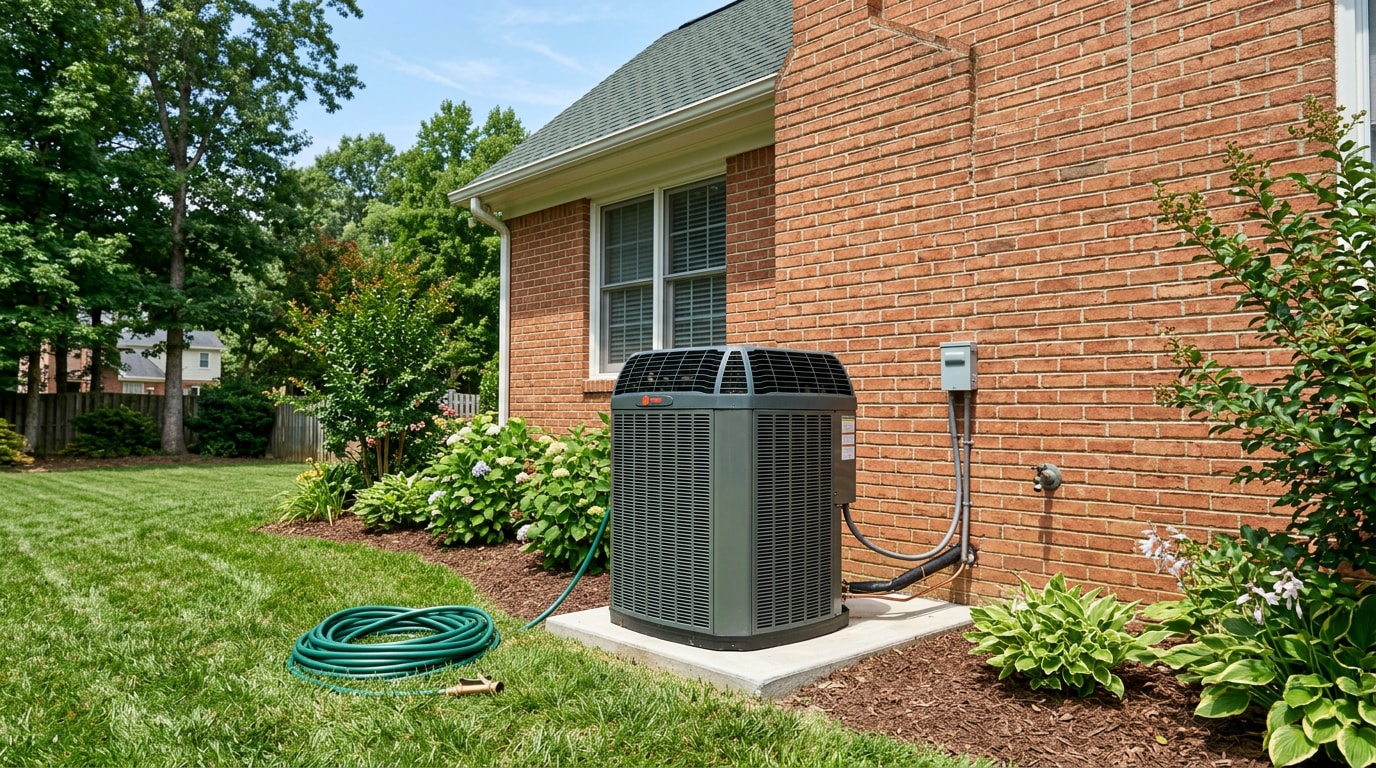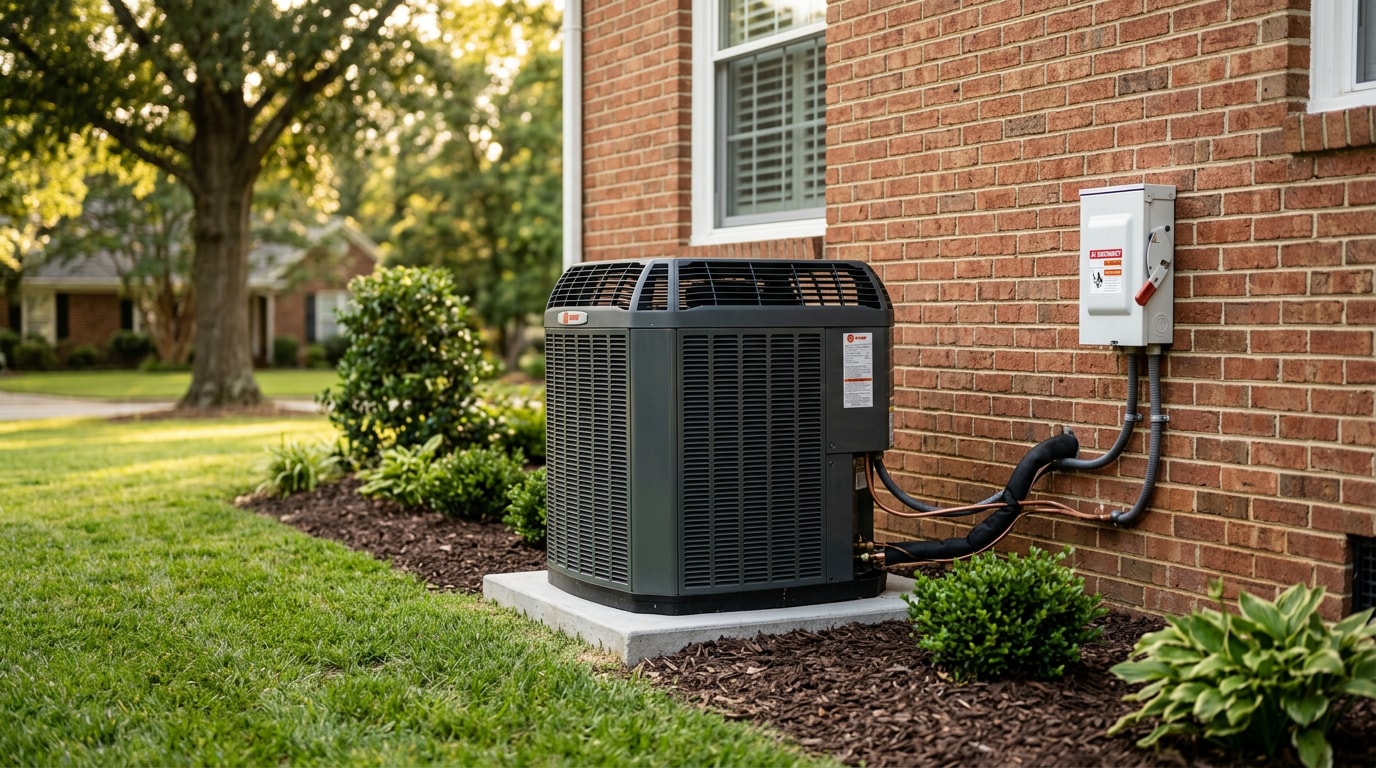
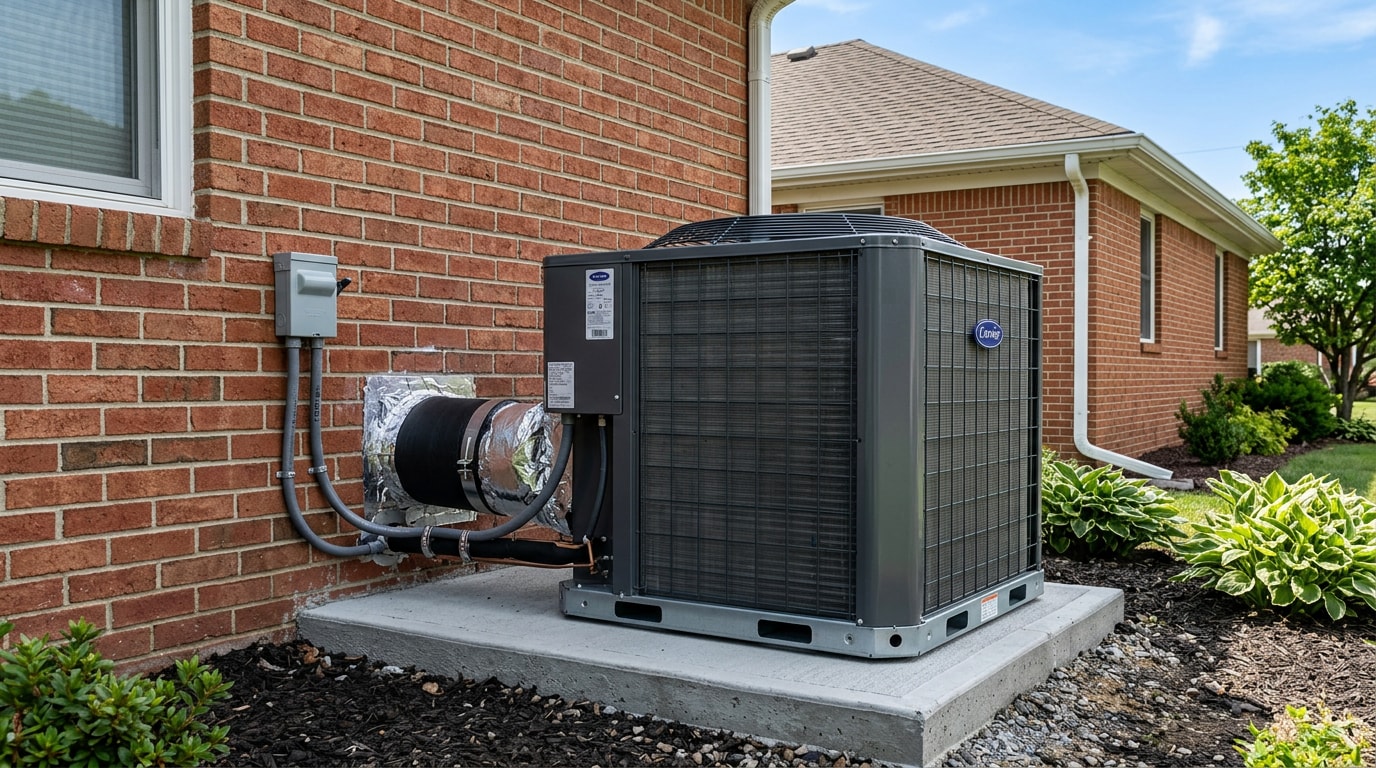
A package unit AC in Brown Summit, NC puts the compressor, coil, and blower in one outdoor cabinet instead of splitting them between an indoor air handler and an outdoor condenser. That single-cabinet design is why you see it on manufactured homes, slab-built houses, and small commercial buildings all over Rockingham County. Here's how the equipment works, what it costs in 2026, and how installation actually goes.
Visit Repair Solutions HVAC to see our services and request a free estimate.
What Is a Package Unit AC?
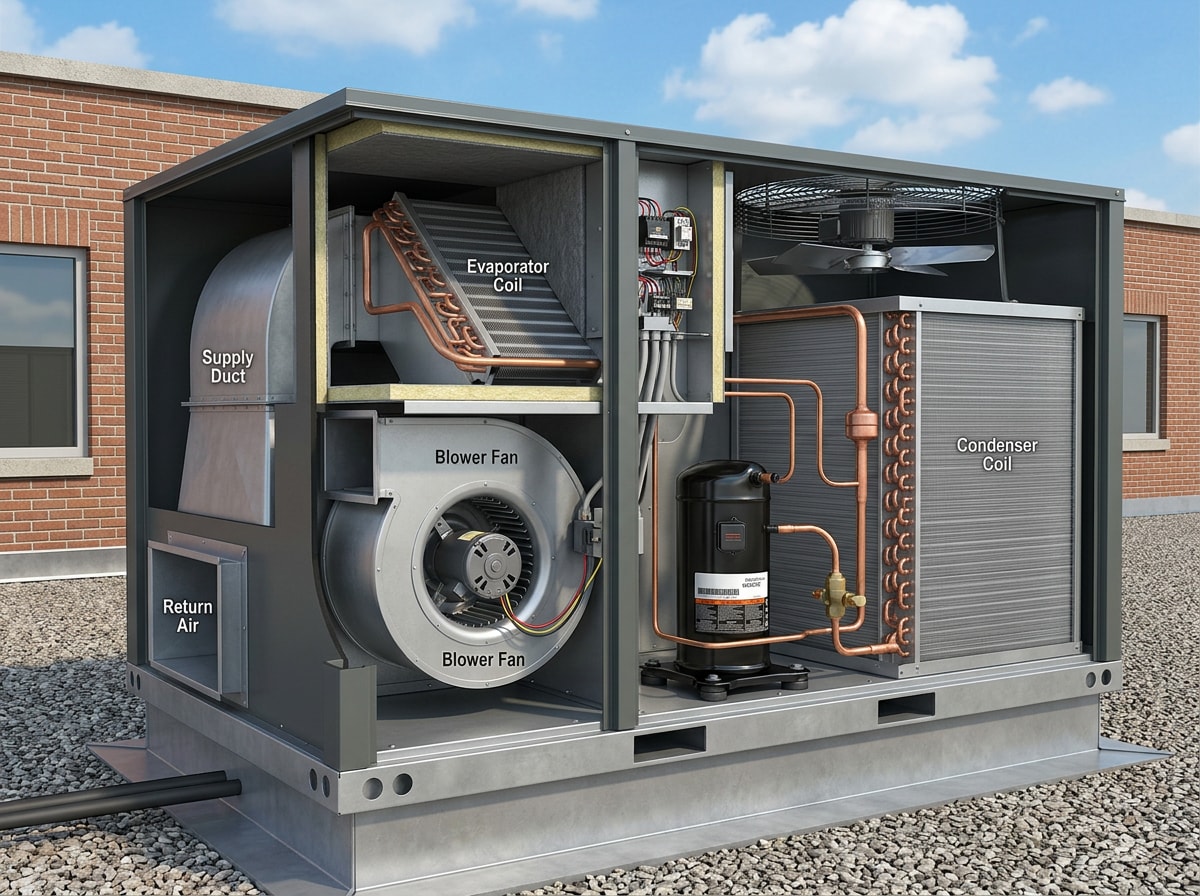
A package unit AC houses the evaporator coil, condenser, compressor, and blower fan in one cabinet, rather than dividing those parts between indoor and outdoor equipment. It connects to the home through duct openings plus a single electrical and refrigerant hookup.
This setup suits homes where indoor mechanical space is tight. A lot of properties around Brown Summit sit on a slab foundation or are manufactured housing, so putting the whole cooling system on an outdoor pad or roof curb frees up the closet or crawlspace a split system would otherwise need.
Our technicians service package units across Rockingham and Guilford counties year-round, from gas pack changeouts in manufactured home communities to rooftop replacements on small commercial buildings. Explore our air conditioning installation services to see how that experience applies to your property.
How a Package Unit AC Works
Warm indoor air gets pulled back through return ductwork and passes over the evaporator coil, where refrigerant absorbs heat and humidity. The blower fan then pushes that cooled, dried air back through supply ducts. Meanwhile the condenser and compressor, housed in the same cabinet, reject the absorbed heat outdoors.
Here's the sequence in order:
- Return air enters the cabinet and passes over the evaporator coil.
- The coil removes heat and moisture from the air.
- The blower fan pushes conditioned air into the supply ducts.
- The compressor pressurizes refrigerant and sends it to the condenser.
- The condenser releases absorbed heat to the outside air.
- Refrigerant cycles back to the evaporator coil to repeat the process.
A control board coordinates these steps, and an air filter protects the coil from dust buildup along the way. Because every part lives in one cabinet, a technician can service the whole system from a single access point.
Main Types of Package Unit ACs
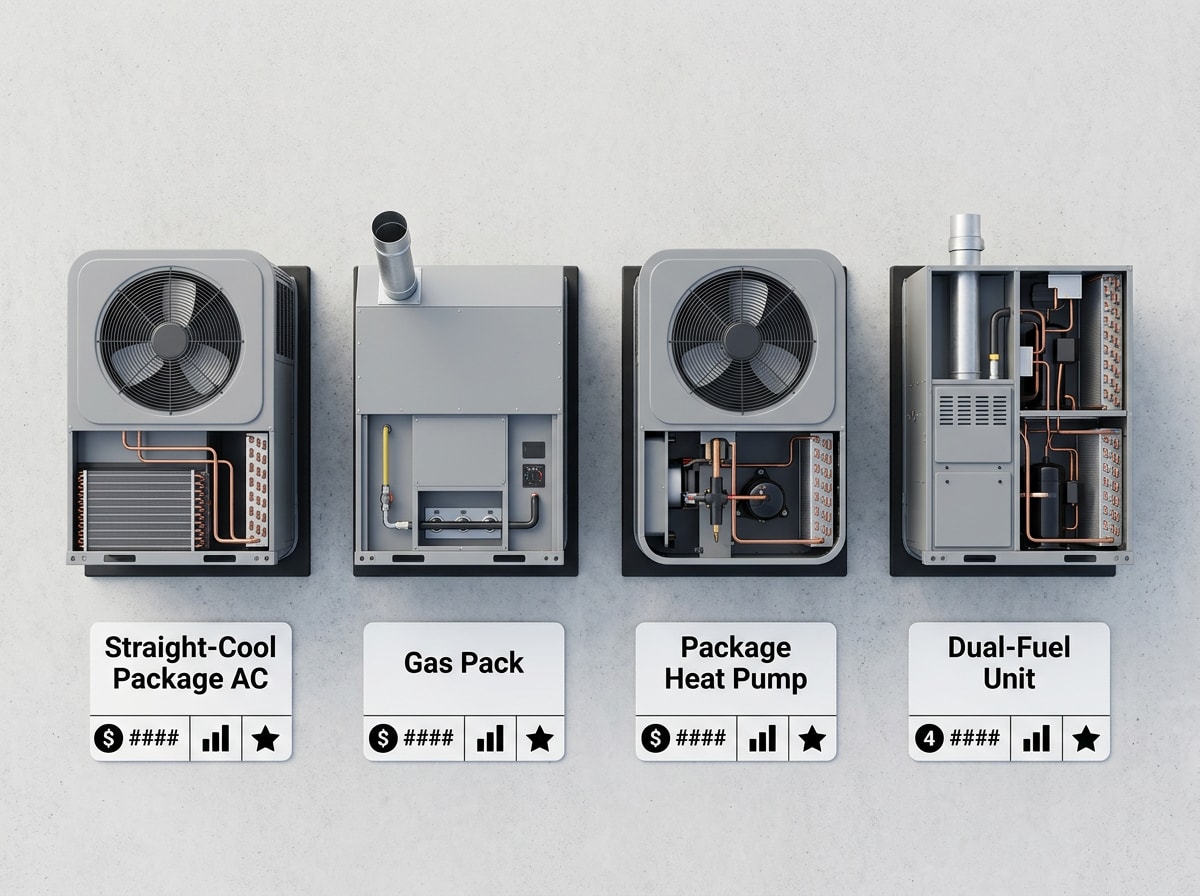
Package units come in four main configurations. The right one depends on how much heating capacity a home needs beyond basic cooling.
Package Air Conditioner Only
This is a straight-cool unit paired with an electric heat strip for supplemental warmth. It suits households that already have another heat source, or that tolerate occasional cool snaps with resistance heat, and it's usually the lowest-cost option upfront.
Package Gas/Electric Unit
Often called a gas pack, this configuration combines air conditioning with a gas furnace inside one cabinet. It's a common pick for homeowners who want stronger heating output than electric strips provide, without a separate indoor furnace. If your current gas pack's furnace side is failing, our gas furnace replacement team can evaluate whether a repair or a full cabinet swap makes more sense.
Package Heat Pump Unit
A package heat pump uses a reversible refrigerant cycle to provide both heating and cooling from one cabinet. Backup electric heat strips typically kick in during the coldest snaps, when the heat pump's efficiency naturally drops. See our heat pump replacement page for how that swap works on an existing pad or curb.
Package Dual-Fuel Unit
A dual-fuel package unit pairs a heat pump with gas backup. It switches to gas heat only when outdoor temperatures drop below the heat pump's efficient range, which can be a good balance for a region where winters swing between mild and genuinely cold.
Package Unit AC Cost in 2026
Cost depends mainly on equipment type, tonnage, ductwork condition, and whether electrical upgrades are needed. A straight-cool unit with electric heat sits at the lower end; gas packs and dual-fuel systems cost more upfront because of the added components.
Package Unit Installed Cost by Type (2026)
| Package Unit Type | Typical Installed Cost Range |
|---|---|
| Packaged AC with electric heat | $4,500 – $7,500 |
| Packaged heat pump | $5,500 – $9,000 |
| Gas pack (gas/electric) | $6,000 – $10,500 |
| Dual-fuel package unit | $7,500 – $12,000 |
These ranges reflect national cost-guide data adjusted for typical Piedmont Triad labor and permitting, which tends to run moderate compared to larger metro markets. Actual pricing still varies by tonnage, electrical panel capacity, and any ductwork modifications needed on-site.
Here's a detail most buying guides skip: federal efficiency rules set a flat national floor for single-package air conditioners of 13.4 SEER2, the same number everywhere in the country. Split systems, by contrast, have to hit a higher 14.3 SEER2 minimum in southern states like North Carolina. The U.S. Department of Energy's current central air conditioner and heat pump standards page lists the compliance dates and ratings in full. In practice, that means a code-minimum package unit can sometimes cost less to meet compliance than a code-minimum split system in our climate zone, even before you factor in installation labor.
If your current unit is past 12-15 years old and repair costs are climbing, a full HVAC system replacement quote is usually worth comparing against another repair bill. Get a free estimate before committing either way.
Is a Package Unit Cheaper Than a Split System?
Package units are often slightly cheaper to install than an equivalent split system, since there's one cabinet and one connection point instead of coordinating indoor and outdoor equipment separately. That comparison should factor in more than sticker price, though. Package units can have a slightly lower efficiency ceiling, and they may run louder since the compressor sits closer to living space. Total value depends on your home's layout and how long you plan to stay in it.
Benefits of a Package Unit AC
The main advantages center on space and simplicity:
- No indoor cabinet. The air handler isn't inside the home, so there's no equipment taking up closet, attic, or crawlspace room.
- Simplified service access. A technician can inspect, clean, and repair the compressor, coils, and blower from one outdoor location.
- Faster service calls. Because there's only one cabinet to open, diagnosis and repair visits often move quicker than on split systems.
- Equipment stays out of living areas. Nothing hums in a closet or crowds a crawlspace.
If a current system is showing its age, our HVAC contractor team can walk through repair-versus-replace options for your specific cabinet and ductwork.
Where Package Unit ACs Make Sense
Package units make the most sense for manufactured homes, slab-on-grade construction, and flat-roof buildings where there's no attic or basement to house a split system's indoor components. That's especially true in and around Brown Summit, where manufactured housing and slab-built homes are common.
Piedmont Triad weather, humid summers paired with moderate winters that still see occasional hard freezes, suits package units reasonably well, particularly gas pack and dual-fuel configurations that handle a wider temperature swing. Correct sizing and insulation still matter more than the equipment type itself.
Permitting and mechanical code requirements vary between Rockingham and Guilford County jurisdictions, so it's worth confirming local rules before installation. Manufactured home installations also need to meet federal equipment standards; HUD's manufactured home construction and safety standards spell out requirements for heating and cooling equipment used in that housing type, including outdoor disconnect labeling for anything mounted outside the home.
Sizing a Package Unit AC
Correct sizing comes from a room-by-room load calculation, not a rough square-footage-per-ton estimate. Insulation levels, window orientation, ceiling height, and local climate data all affect the real load a home needs.
Getting this wrong causes real problems:
- An oversized unit cools the air quickly but shuts off before removing humidity, leaving rooms feeling clammy.
- An undersized unit runs constantly, struggles on the hottest days, and wears out faster from the extra cycling.
Sizing also drives cost directly. Larger tonnage means a bigger compressor, more refrigerant, and often heavier electrical requirements, all of which raise equipment and installation price. The accepted load calculation method is ACCA's Manual J standard, which protects against paying for capacity you don't need or installing a unit that can't keep up. Schedule a free sizing estimate rather than guessing at tonnage.
Package Unit AC Installation Process
A professional installation moves through several distinct stages: site prep, placing the cabinet, electrical and duct connections, safety checks, and startup testing.
Site Preparation & Choosing a Location
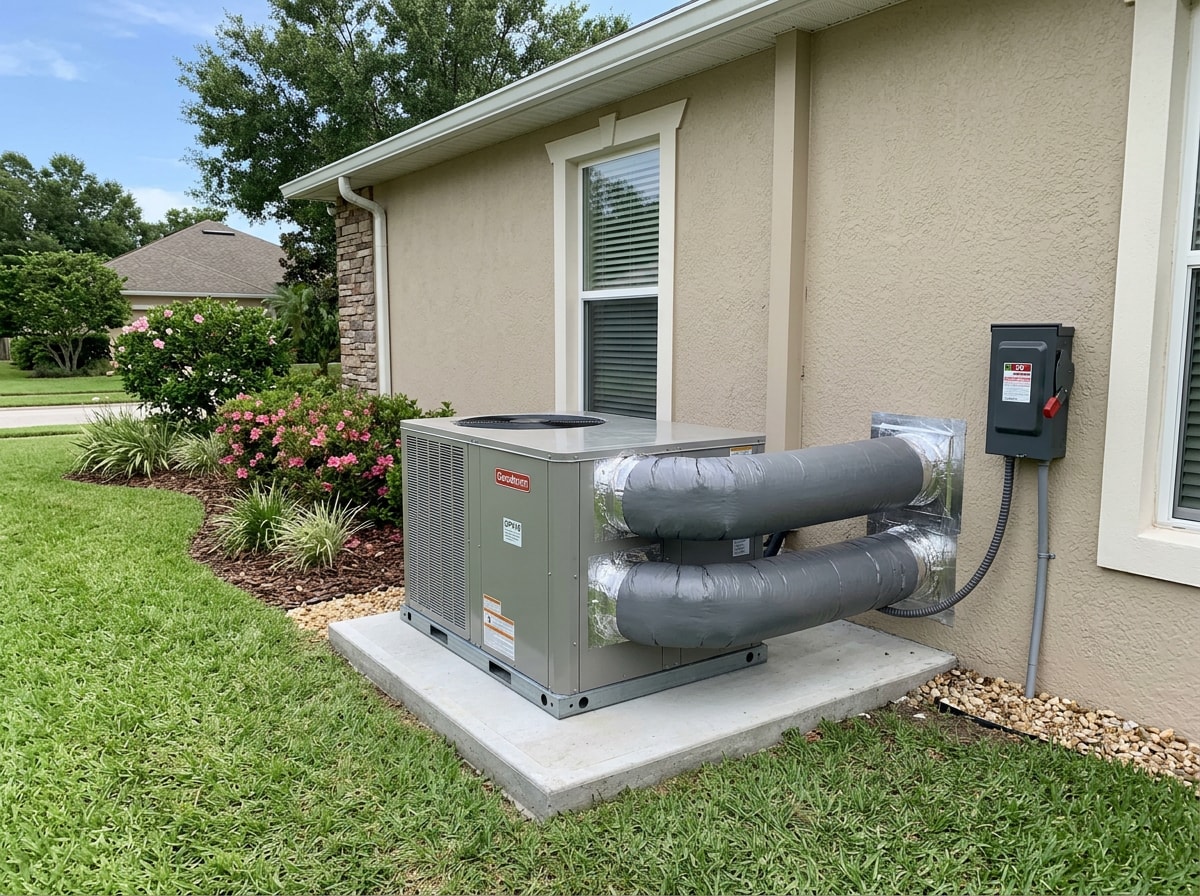
Package units need a level, stable foundation, usually a concrete pad at ground level or a roof curb for flat-roof commercial and some residential setups. The spot needs enough clearance for airflow and future service access, and it should avoid low areas where water pools after heavy rain.
Safety Measures During Installation
Technicians disconnect power at the breaker before any electrical work begins and follow manufacturer guidelines for clearances and wiring. Disconnect procedures and conductor sizing should align with requirements in the National Electrical Code, NFPA 70, which governs clearance distances and disconnect accessibility for HVAC equipment. These are code-driven steps meant to prevent shock and fire hazards, not just general caution.
Mounting, Connections & Post-Installation Checklist
Once the cabinet is mounted and leveled, ductwork connects to the unit and gets sealed with mastic or foil tape to prevent air leaks. Electrical hookup runs to a dedicated circuit sized for the unit's draw, and thermostat wiring connects the control board to the indoor thermostat. Startup testing then verifies refrigerant charge, confirms airflow across all supply registers, and checks that safety switches respond correctly before the crew leaves.
Maintenance Tips for Package Unit ACs
Routine maintenance matters more for package units than split systems, since every component faces outdoor weather exposure year-round.
- Change the air filter every one to three months to keep airflow steady and protect the coil.
- Clean the coil periodically to remove debris that reduces heat transfer efficiency.
- Check the condensate drain regularly to prevent water backup that can damage the cabinet.
- Clear leaves, grass clippings, and other debris from around the unit a few times a year, since restricted airflow forces the system to work harder than it should.
Common Package Unit AC Problems and Troubleshooting
| Symptom | Likely Cause | Who Can Fix It |
|---|---|---|
| Weak airflow | Dirty filter or coated evaporator coil | Homeowner (filter) or technician (coil) |
| Water pooling near the cabinet | Clogged condensate drain | Homeowner or technician |
| Shorter equipment lifespan | Accumulated outdoor debris or corrosion | Technician inspection recommended |
| Not cooling despite running | Refrigerant leak or electrical fault | Licensed technician only |
Some of these are simple homeowner fixes, swapping a filter or clearing debris takes minutes. Others, like refrigerant leaks or a unit that won't cool at all, need a licensed technician with the right tools and training to diagnose safely. Condensate backups are a frequent culprit behind water damage near the cabinet; our guide on AC leaking in Brown Summit, NC covers the most common causes and what repairs typically cost. For anything beyond basic cleaning, browse our air conditioning repair services or contact us to get a technician out.
FAQ
How should I size a packaged air conditioner?
Proper sizing comes from a Manual J load calculation that accounts for your home's insulation, square footage, windows, and local climate, not a flat square-footage-per-ton rule. A licensed technician can run this calculation and recommend the correct tonnage for your specific house.
Is a package unit cheaper than a split system?
Package units are often slightly less expensive to install upfront since there's one cabinet instead of separate indoor and outdoor equipment. Total value still depends on efficiency needs, noise tolerance, and how your home is laid out.
Can a packaged heat pump replace a conventional packaged air conditioner?
Yes. A packaged heat pump can replace a straight-cool package unit and add heating capability in the same footprint. Backup electric heat strips typically handle the coldest days when the heat pump's efficiency drops.
How much does it cost to replace an HVAC package unit?
Installed replacement costs typically range from about $4,500 for a basic AC-with-electric-heat unit to $12,000 for a dual-fuel system, depending on tonnage and electrical work needed. Getting a few quotes helps pin down the actual number for your home.
How long does a package unit AC last?
Most package units run 12 to 15 years before major components need replacing, a bit shorter than some split systems since every part sits outside in the weather year-round. Regular filter changes and coil cleaning help equipment reach the higher end of that range.
Does a package unit need a permit in Brown Summit, NC?
Replacing a package unit typically requires a mechanical permit, and sometimes an electrical permit if the circuit changes. Requirements vary between Rockingham and Guilford County jurisdictions, so confirm with your contractor before work starts.